
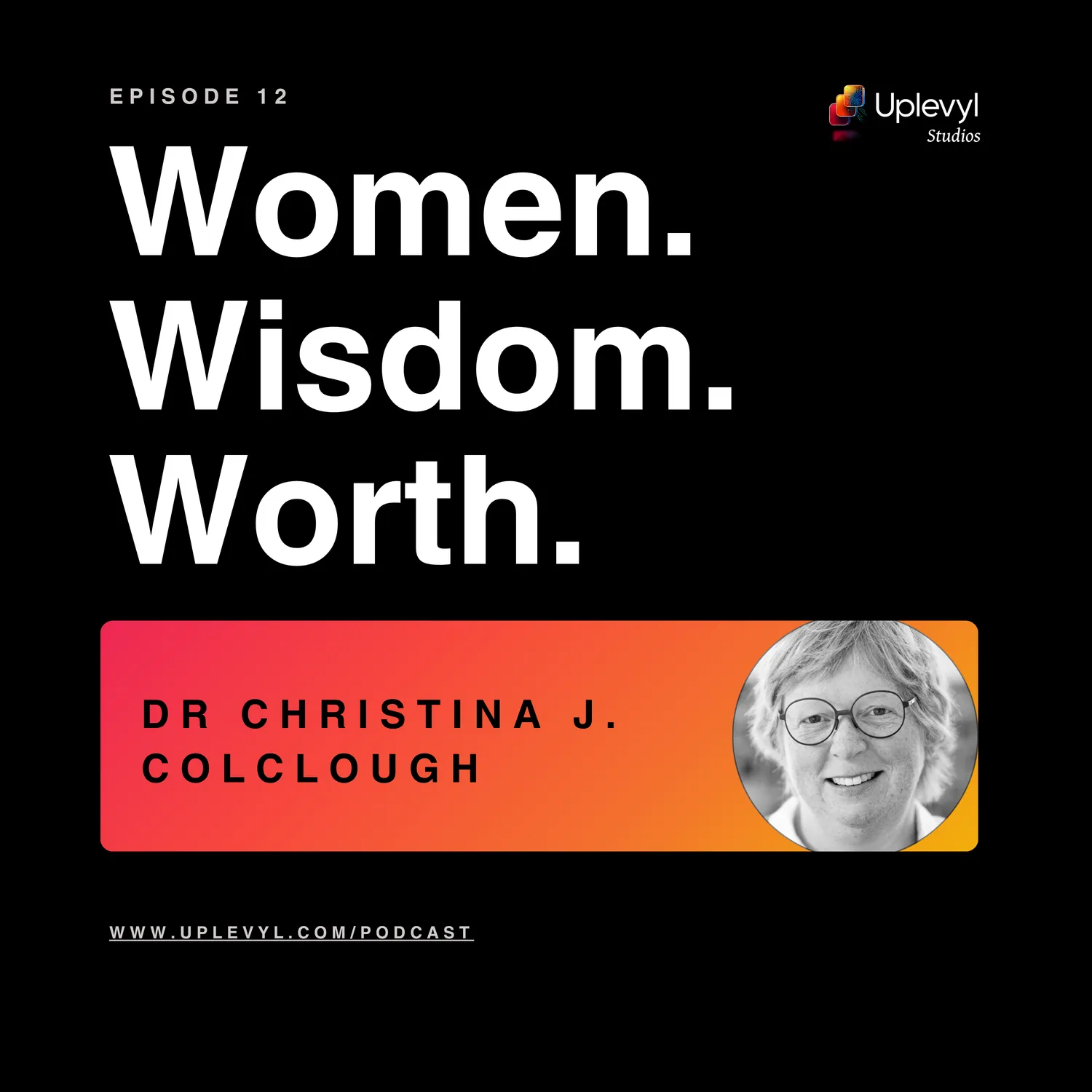
VO: Welcome to "Women Wisdom Worth," the podcast series from UpLevel, where we learn from women around the world about what they're doing to find success and joy in this digital age. For show notes and free bonus resources, simply visit www.uplevel.com/podcast. We'd love it if you subscribe, like, leave a nice review, and share the show with your friends and colleagues. And remember to check out UpLevel: UpLevel is the global leader of women-trained generative AI transforming society and business, featuring women-centric data inputs, insight, and advice. You'll find all the answers you need and a way that works for you as you navigate the complexities of modern life. Check it out on uplevel.com. Let's get started with your host, Sarah Beauslais. Over to you, Sarah.
Sara Bhonsale: I am so thrilled to welcome Dr. Christina Colclough, a globally recognized voice at the intersection of labor rights, AI ethics, and the future of work. Christina is a powerful advocate for workers' rights in the digital age. She's known for her work in shaping fair and responsible policies around data and technology in the workplace, and she is also the founder of the Why Not Lab, where she consults with organizations and policymakers on creating ethical and inclusive practices that prioritize people alongside technological progress. Christina's expertise spans across AI governance, labor standards, and digital rights, with her insights guiding major global bodies, including the International Labor Organization, UNESCO, and the Global Partnership on AI, as well as the OECD. She is a speaker, she is a strategist, and she is a thought leader. She's continually challenging the status quo, encouraging leaders to prioritize ethical principles in the adoption of technology. And today, we are so excited to hear your perspective on how AI is reshaping the labor landscape, what it means for workers' rights, and we'll talk about the critical role that women can play in leading these changes. So welcome, Christina. Thank you so much for joining us today.
Dr Christina J. Colclough: It's an honor. Thank you for inviting me.
Sara Bhonsale: Oh my goodness. So much to talk about today with your expertise. I would love to hear about your journey. So can you share a little bit about your path to working in labor rights, AI and ethics, and how this all came together? Were there, like, experiences that sparked your interest in how AI impacts workers and specifically the role of women?
Dr Christina J. Colclough: Yeah, for sure. Well, it really starts before AI became the thing everybody was talking about. It was back in the days of data.
And I'm a survivor and have, therefore, a bit of a medical history. And when I was living in Belgium, I got myself a Fitbit, and it really helped me. You know, I did those 10,000 steps, so I swam 10 more lanes or whatever it may be. But my neighbor, he worked in the Ministry of IT in Belgium, and him and his wife, I used to hang out with them a lot. And one day I went down for dinner, and he sort of frowned and said, "You do know that that company now is tracking everything you do and what you're not doing, your heart rate and everything."
Sara Bhonsale: Right.
Dr Christina J. Colclough: And I started going, "Hmm?" And that got me into this whole thing: what is data? How's it being used? And then, of course, because I was working for one of the European Union federations, I was the head lobbyist there in relation to the Parliament and the Commission in Europe, I started really thinking about, well, what rights, what protections do workers have in relation to all of this data? And that was what really sparked my whole career.
Sara Bhonsale: Wow. Started with a Fitbit. It's kind of fun.
Dr Christina J. Colclough: It started with a Fitbit. Needless to say, I haven't used that Fitbit since.
Sara Bhonsale: You know, I think we all had that moment at some point in time when, whether or not we were working, it doesn't matter what field we're in, but just that moment where we connect the idea that somebody, somewhere, is metabolizing this data and doing something with this data. And what are they doing? How can we know? How can we protect ourselves and even know what is happening with the data? So interesting because that evolved in your career from a place of, like, just protecting workers, right? Or not just, but, I mean, exceptionally protecting workers, and then having that aha moment of, "This is important, and I need to be able to speak to this as well."
Dr Christina J. Colclough: Yeah, exactly.
Sara Bhonsale: Can you talk a little bit about what happened from that point when you realized, "This has an impact in my field and my day-to-day with the workers that I'm working with"?
Dr Christina J. Colclough: Yeah. Yeah, thanks. No, I mean, this was back in 2014, '15. And at that point, the European Commission came out with something they called a Communication on the Collaborative Economy. That's what we now know is the gig economy. And several of the committees in the European Parliament, they asked me to help them sort of write a response to this. And from then on, I could see, really, that workers' rights are poorly regulated, that we are actually returning to something that we swore in the Treaty of Versailles and the Declaration of Philadelphia, which was signed in 1944, that labor is not a commodity. And what I was seeing is that all of this datification, the influencing that's happening, is turning de facto labor into a commodity.
So fast forward some years, I started working globally and was tasked by my boss to write the principles for workers' data rights, but also for the ethics of AI. And this was in 2017. So I did that, and that became then the labor movement's first principles and all of this. And since then, I have to say, of course, it's all sped up. Developments are happening fast. But the realization that, despite what many of our governments are saying, that their regulatory proposals will protect fundamental rights and freedoms, they're actually doing the opposite. So we have a lot to do. It's an uphill battle. But essentially, this is about protecting all of ours, workers, managers alike, citizens as well, our fundamental rights and freedom, and not least autonomy.
Sara Bhonsale: And so where did the Why Not Lab come to be in all of this?
Dr Christina J. Colclough: So the more I worked on this and the more I could see what needed to be done, and the more I realized I have to focus on this 180%. And when I was working for the Global Union, I had lots of portfolios, and I just thought, "I need to be able to do this 180%." So ironically, I left the union movement to serve workers across the world and started the Why Not Lab as a dedication to improving workers' rights, their capacity, their knowledge about all of this, but also to continue the work I was doing in all of these multinational organizations.
Sara Bhonsale: Fantastic. There's so many people that I have spoken to just by doing this podcast and being a part of UpLevel that have thought, whatever this impetus was to create change, almost like this entrepreneurship idea of, "I can do it within the confines of my affiliation with whatever organizations I'm working with." But one thing I've noticed is it's so inspiring to see and hear people like you who say, "I have to commit to this more than time allows me to do so." And being able to do this on your own, it's super inspiring.
Dr Christina J. Colclough: Thank you.
Sara Bhonsale: I'm curious about women in particular. Do you find that there is either a disparity or, in the other case, you know there's more of a danger gender-wise when we're talking about AI and the impacts of labor? So that's a big question, right?
Dr Christina J. Colclough: It's a big question. I mean, so yes. I mean, let's have the gender lens on here. Now, if we just look at the seatbelt, the seatbelt that we all have to wear when we're driving a car, it wasn't until recently, for the first time in 60 years, that a car crash test dummy actually represented the average woman. The first time in 60 years. Yet women are 17% more likely to die in a car crash and 73% more likely to sustain serious injuries. Despite that, and this is just incredible, that companies' car crash test regimes really only require that they're tested on male dummies. So what can we learn from this?
What we can learn, of course, that the world is diverse, that the impact of digital technologies, including AI in all of its various guises, will impact various groups in society differently. And the same, of course, with women. And this is why I've been calling for, for a long time now, something I call inclusive governance, that all AI systems, they have to be monitored, governed ongoingly by a diverse group of people and not just done by the legal compliance team and then that's it. So I think this seatbelt really shows that unless we realize, not just in theory, but especially in practice, that the world is diverse, that experiences vary, and therefore we should hear these voices, then there's no way that AI is going to be good for humanity.
Sara Bhonsale: So I love this metaphor or this example of the seatbelt. And I think the follow-up question is the idea that diverse voices are important when we're talking about fair practices or safety, right? So how do you see, in particular, women's perspectives shaping these ethical standards and specifically in AI?
Dr Christina J. Colclough: So we've got to be careful when we say women. We mustn't talk of women in the singular, so to speak.
Sara Bhonsale: Okay.
Dr Christina J. Colclough: Because there's all sorts of women. There's women of color, there's women of age, there's women of different geographies.
Sara Bhonsale: Sure.
Dr Christina J. Colclough: So we have a big problem already there, but just say, "Well, we have to have more women at the table." Well, who? Which? And especially well knowing that there's not a single AI system in the world that is 100% fair to all of the subjects of the system.
Sara Bhonsale: Absolutely.
Dr Christina J. Colclough: What we typically say is that digital systems marginalize the already marginalized. So there's a good place to start. If you're rolling out as a public authority a system to help in your social benefits or job matching with the long-term unemployed, well, then trigger the thought, inclusive governance, how can I welcome to the table not just various groups of academics to do the governance or do the standards of all of this, but also the subjects of these systems? How can we welcome them in, hear how they experience this technology, what are their questions, queries, concerns, and so forth? So for me, this is particularly important that we adopt this intersectional understanding of gender, of women.
Sara Bhonsale: Yes. Yes.
Dr Christina J. Colclough: But diversity and inclusivity, those are the two key words.
Sara Bhonsale: Diversity and inclusivity and the idea that there is intersectionality. And I think that that is really important. And I do want to stress, I love what you said. It is women of color. It is women who are in a different socioeconomic bracket. You know, like.
Dr Christina J. Colclough: Exactly.
Sara Bhonsale: There is this idea of intersectionality. And there is a danger when we use the binary, right? Or if we put women just in the binary. So my next question to you is, how do we do that? How do we ensure fair practices? How do we ensure, you know, as we're developing these ethical standards, that we are inclusive? How do we do that?
Dr Christina J. Colclough: Well, it's a question of will.
Sara Bhonsale: That's a big question.
Dr Christina J. Colclough: That's a big question, too.
Sara Bhonsale: It's a big question, too.
Dr Christina J. Colclough: No. So we're talking on two different levels here. We're talking of, firstly, those who are creating the standards, the guidelines, the frameworks, whatever you want to call it. And then we have the ongoing governance, which must or should take place by any entity, be it public or private, who's deploying these systems.
Sara Bhonsale: Yes.
Dr Christina J. Colclough: So if we take the standard body first, now they are highly unrepresentative. They are full of academics, mainly, mainly men, and mainly representatives of industry.
So already there, we should start thinking, although anybody who sat on the standard body knows how complex it is to mold the social world into a standard, but how could we there welcome in a multitude of voices, especially those who aren't wearing an academic hat? So that's number one. And then number two, on the deployment level, and then we also, of course, have the developers. We can come back to that.
But on the deployment, so if it's a public service using this, well, then we have some wonderful examples of citizen assemblies being used in various fields, but also, you know, in the public sector, bring in, as I said before, representatives or the subjects themselves. If it's in a workplace and it's an algorithmic management system, we'll then bring in workers and/or their representatives, the labor unions. So here you see is it can be done. It's relatively, I won't say simple, but straightforward. But we're touching also on one of the paradoxes of our time because these technologies are sold, in inverted commas, to us as improving productivity, efficiency, being smart, almost condensating time to nothing.
Sara Bhonsale: Sure. Sure.
Dr Christina J. Colclough: Yet to get it right takes time. And this we have to overcome that seemingly, but a false paradox, right?
If we truly want to protect people, people's interests, diversity, respect, well, then that takes time. Unfortunately, what I see around the world in almost every single country that I'm operating in is a lot of the deployers who are deploying these technologies themselves don't understand their potential scope. So, you know, we have people who are deploying technologies they don't understand. We have subjects who are not heard. And then we can ask, well, where's the power going? And the answer to that is into the hands of the very few.
Sara Bhonsale: So that's heavy.
Dr Christina J. Colclough: Yeah. But it's true. That's what's happening.
Sara Bhonsale: It's so insightful. I want to come back to this idea that we are this paradox of we are being shown. I mean, I've had so many conversations on this podcast about, "This is wonderful. This is going to increase productivity. It's opening the doors for so many people. It's increasing efficiency." But when you come back to the development as opposed to the deployment oh, I mean, the deployment happens very quickly. The development is also happening quickly. Is that how I understand? And we're not bringing the voices. So how do we do that? How do we slow down? I mean.
Dr Christina J. Colclough: Well, let me give you a little example of the simplicity of the how.
Sara Bhonsale: Okay.
Dr Christina J. Colclough: So some years ago, I gave a speech at NEURIPS. This was in Montreal, I think it was. And it was on AI and human rights. And we were three people speaking there, and the room was packed with developers. And afterwards, there was a queue, as long as I can I can't even tell you how long it was, of people wanting to know more. Now, one of them who came up to me, he was a young guy, and he had tears in his eyes. And he says, "I'm so touched. I have never thought about all of this." And I said, "Well, who are you?" And he says, "Well, I'm a developer. And I work for one of the big tech companies. And what can I do?" he said. And I said, "Well," I said, "your friends. Are you a trained computer scientist?" Yes, he was. I said, "Are all your friends computer scientists?" "No, they're various things." I said, "Great." I said, "Next time you're asked to code something or you yourself think of a code, invite your friends around for a drink and do a 360-degree discussion over this. What could be a harm? Who could this benefit? Who could it not benefit? What were the risks of this system?" I said, "Send me a picture when you've done it." And then, you know, so he did this three times and thumbs up. And then the fourth time, he wrote to me and he says, "I've done this now four times and I've resigned from my job. I can no longer work there," well knowing the consequences of or potential consequences of what we're doing.
So to answer your question, the developers, and there are now legal requirements, for example, in the European AI Act, there's very stringent requirements on developers and deployers to do fundamental rights impact assessments and so on. So the developers themselves, they need to, or at least the companies need to bring in experts who can help them analyze this and do their impact assessment. The deployers as well will be forced to actually do their own assessment. But you see, what's lacking here is the inclusivity, is including the voices of the subjects of these systems. You know, we know what it's like if we sit in a room full of people who remind us of ourselves, then we're lacking diversity. We're just confirming one another in our own belief systems.
Sara Bhonsale: Right.
Dr Christina J. Colclough: So if you have a room full of developers or a room full of white people who are trained human rights specialists, well, you know, that's not inclusive.
Sara Bhonsale: Right.
Dr Christina J. Colclough: So this is something we'll have to strive for, embrace diversity and welcome it in. And this includes, of course, not least, the underrepresented groups of women.
Sara Bhonsale: Absolutely. And then to reiterate the intersectionality of women and not, you know, the binary. So it is possible. It can happen. I love that you gave an assignment and somebody was responsive to it. I don't love that they resigned from their position where there was power and control to do something about this, right, and bring in that inclusivity. Do you think that it's possible to scale that? Do you think it's possible to create a ripple effect, maybe in the work that you're doing to protect workers and ensure that there are guardrails in place? Are you hopeful? Do you think that can happen?
Dr Christina J. Colclough: Yes. I'm hopeful, but I'm also doubtful. I'm hopeful because this makes sense. You know, in every single discussion I have with politicians or senior civil servants, I said, "Tell me why this doesn't make sense." Then I typically hear, "Oh, it's a burden. It's a regulatory burden." And I said, "Okay, let's stick with that then. It's a burden. Yes, it will take time. Yes, oh, how do you find the subjects and all of that?" But you also claim that your regulation will protect fundamental rights. So protecting fundamental rights is a big thing. You know, you're talking about ethics. But as the former Human Rights Commissioner of the United Nations said to me once, which was so wise, he said, "Ethics are essentially political. Are your ethics better than mine?" We can have a debate about that. Human rights, on the other hand, are absolute. They're non-disputable. We might be very bad at actually living up to them, but they are absolute. So going back to this, "Oh, this is a regulatory burden, this smacks of administration and all of that." Well, then I would turn around and said, "So will you consciously and willingly do harm, well knowing that no system is 100% fair?" And this is where we have to get to. We have to, once again, look around, look at the people around us, workers, citizens alike. We have to look at our planet and say, "Well, are these systems really that productive and effective if we count in the environmental degradation or the carbon dioxide emissions from the data centers and all of this?" So we have to be critical. And we can't just get the quick fix at any cost because just look around at what's happening to our world socially, environmentally, and we can no longer continue as we are.
Sara Bhonsale: Sure.
Dr Christina J. Colclough: Full stop.
Sara Bhonsale: So how do you.
Dr Christina J. Colclough: So I am hopeful, yes.
Sara Bhonsale: I want to scale what you're doing. I want to bring more people into this space. I want to bring more intersectionality into this space. How do we do that? How do we get everyone on the bus with us, you know, and maybe even bring more women into roles related to ethics and governance or even just policy-wise? You know, how do we do this?
Dr Christina J. Colclough: So my experience really is that the first step is we need to know what we need to know.
Sara Bhonsale: Okay.
Dr Christina J. Colclough: A lot of what is happening right now in relation to the commodification of citizens and workers, in relation to what I call the algorithmic manipulation that's continuously taking place, is occurring because we've been lured into the smartness of all of this. You know, as Roosanna Zuboff from Harvard Business School so correctly says, "Everything we call smart, we should call surveillance, surveillance phone, surveillance home," you know, etc.
Sara Bhonsale: Sure.
Dr Christina J. Colclough: But we've been lured into the smartness. Tim Wu, back in 2018, he called this a tyranny of convenience. So we might know that we're paying with our privacy, or we might have an inclination that somebody's getting hold of the photos of my baby or whatever it may be. But we still think, "Oh, I can't do without this. It's so smart. It's so efficient." Or it's so, you know, all my friends on this social media or whatever. So we need to know what we need to know. In other words, currently, we don't know what we don't know. So we need to really help the public understand these technologies so that we can start building a critical sense, resilience, and ultimately resistance to it. So that's number one. Number two, I know a lot of amazing women in the field of AI governance or the ethics of AI and human rights and all of this. So there, we don't, you know, we're not lacking women, so to speak. We have a wonderful diversity of women from all corners of the world. But then something very interesting happens. If you look at the workplace, suddenly AI governance either becomes a legal thing just to get over and done with, or it gets regarded as human resource department was regarded and still is, something soft, not as valuable as the finance department or the sales department.
Sara Bhonsale: Right.
Dr Christina J. Colclough: And typically, typically in workplaces, it's females who are doing the governance. So here we already have an equality problem. So those doing the governance or human resources, typically, not exclusively, are women, paid less, have less of a position in the workplace, and are taken less seriously.
Yet I would argue that the ethics or the impacts of these systems should be taken with the greatest of seriousness.
Sara Bhonsale: Absolutely.
Dr Christina J. Colclough: So here you have gender segregation of the labor market, you have wage segregation, etc., etc., and all of that that we well know. So we have a major issue here of now looking at and hoping any boss who's listening to this really revisits their organizational structure and say, "Do we put enough importance and emphasis and resources into the whole department of data and AI ethics, governance, etc.?"
Sara Bhonsale: So how is the Why Not Lab working to do that and change that idea that human resources is less valuable or, you know, the governance? How do we amplify that governance is the essential piece of what a business is doing? How is the Why Not Lab doing that?
Dr Christina J. Colclough: Well, firstly, I think the moment that the workers in my case, because it's those I focus on mainly, they start asking questions. So, you know, who's the developer of these systems? Have you negotiated limitations on what they can do with our data? You know, have you in your procurement process ensured that there's environmental degradation accounting of this digital system? Have you ensured that you have a right to demand that the algorithmic system is changed if harms are caused, for example? So when the workers start asking these questions, at some point, management or the employer needs to answer. And then I think the more questions they get, the more they realize they should be able to answer these. Right now, what we see is what I call in many workplaces, managerial fuzz. So maybe the C-suite has decided that, "Oh, we should have this new chatbot or this new tool because the competitors have them, and they get the IT department to vet, you know, what's on the market. They get the finance department to do a cost-benefit. They get the legal department to do a legal review. But then it's the HR department who'll be using this tool."
Sara Bhonsale: Right.
Dr Christina J. Colclough: Which of these managers is actually responsible for the governance? Where in the process of buying this tool or licensing it has the governance taken place before the contract was signed or after? So all of these questions are something, you know, this managerial fuzz needs to be sorted out. It needs to have very new and clear structures within a company or in a public service to center this governance issue, which will be mandatory by several laws, but of course, not in all laws across the world. So that's one major thing.
Sara Bhonsale: Yeah. And it sounds like the idea of advocating for the workers and starting this at the workers has the potential to clear up that managerial fuzz, like working from the bottom up.
Dr Christina J. Colclough: It's an avenue, right? But I would also, I'm also working with some companies who want to become more ethical or responsible around the use of these technologies. And there, it's also very clear that there's, again, there's no quick fix to this.
Sara Bhonsale: Right.
Dr Christina J. Colclough: But you have to have the curiosity and the will and the knowledge to realize that you could do great harm with these systems.
Sara Bhonsale: Yes.
Dr Christina J. Colclough: Unless they are continuously governed and responsibly. So, you know, the push, the pull can come from above, from legal requirements, can come from a normative requirement, can come from public sentiment, but should essentially come from a knowledge base that says, "Well, we have the responsibility, we have the obligation, and we have due diligence procedures in place here to realize that what we have between our hands is potentially very powerful for right and for wrong."
Sara Bhonsale: So the idea, I want to come back to this hopeful place where it is the organizations themselves acknowledging, I want to, that they want to be sure that they're doing this right. Do you believe that there are policies that create an environment where it is coming from the top and they do want to get ahead of this and they do want to have ethical practices in the development? Are there particular policies or strategies that you've found, like, lend themselves to an organization making the decision to do this without it having to come from the place of employees advocating for themselves?
Dr Christina J. Colclough: Of law.
Sara Bhonsale: Exactly. Or of law, yes.
Dr Christina J. Colclough: No, to be honest. And mainly, well, of course, there's some good examples, but they're few and far between because we live in a market, you know, controlled capitalism.
Sara Bhonsale: Sure.
Dr Christina J. Colclough: And as long as the market doesn't value ethics, doesn't value good governance, or reversely, doesn't penalize the lack of governance, the lack of ethics, well, then, of course, every person, CEO in a company or everybody responsible for the budget line is going to say, "Well, this might make us look good, but we really, you know, can't prioritize this higher than to such and such an amount." So we have to change the market, right? We have to change what the market rewards and doesn't reward. And that's, again, some would say, "Oh, impossible task." But that's not true. The market is man-woman-made.
Sara Bhonsale: Yes.
Dr Christina J. Colclough: So we can put the frames on that market.
Sara Bhonsale: Yes.
Dr Christina J. Colclough: So no, self-regulation, I'm sorry, I don't believe in it. We have to make sure that the market, the frames around the market have changed. And I think we will need, until that happens, a top-down legal push.
Sara Bhonsale: And that's why you're doing the great work that you are doing and.
Dr Christina J. Colclough: I'm trying very hard.
Sara Bhonsale: I think you are. I love this. I love that you're out there advocating to do this the correct way. It sounds like, again, this idea that you're the entrepreneur who said, "I have to, this is important to me, this is important to the world, so I have to do this and I have to commit to this." And I just think that that's phenomenal. It's inspiring. It really is.
Dr Christina J. Colclough: Oh, thank you. It has also, of course, a personal background, right? Because I was burial with a brain tumor and luckily survived. That created the urgency of now. We only have now. We don't know what tomorrow brings. And I think that has really also put more fire under my "I must do this."
Sara Bhonsale: Yes.
Dr Christina J. Colclough: So it's about finding that passion, finding that reason to realize that, you know, everything in the end of the day melts in the air, so to speak, and therefore we should do what we can do. But I do want to add one comment, if I may, just go back. And on the burden, so to speak, which I don't want to use that word, but I understand why a lot of corporations feel it is, there are many, many frameworks out there right now around corporate due diligence, around human rights, around the ESGs, around all of this. And I understand if there's confusion, right? And I think if we look in a really good space, and I work in the UNESCO Women for Ethical AI Advisory Group, and there we're creating actually some principles or a framework for assessing digital technologies from a gender perspective.
And it's not going to be 150 questions and, you know, 200 impossible answers or questions to answer, but it's going to be something that asks those necessary questions to begin this reflection, to begin this investigation between the deployers and developers about the training data, about indirect, direct discrimination, and so forth. So there, you know, there are good tools out there. And I think as we move along in time, I think a lot of the sort of disjointed frameworks that exist right now will be, there will be some form of global governance of all of this. We just need our politicians to take responsibility.
Sara Bhonsale: And people like you who are doing the good work, you know, connecting the two of those things together.
Dr Christina J. Colclough: And many are. Many are.
Sara Bhonsale: And many are. And many are because of the work you're doing. Again, it is just such an inspiration. This has been fantastic. I appreciate all the work you're doing. I appreciate your hopefulness. I want to close with any final advice, and what you said really resonated. We don't know what tomorrow will bring, this idea of now. I'm happy to see you looking healthy. I'm happy to see you continuing this impetus of work that needs to happen. What advice, what closing advice do you have, especially for the intersection of women who are listening to our podcast as we don't know what tomorrow will bring?
Dr Christina J. Colclough: Talk, talk, talk to one another. You know, if you are a boss or you're a worker somewhere and you know that there's a digital system being used, you know, have a chat with your colleagues and say, "Have we looked at how this system actually functions or impacts diverse groups of subjects?" Or if it's an internal tool that's measuring your productivity, "Has this been assessed from a gender perspective?" Or, you know, if you're a developer, "Oh, as soon as we launch the UNESCO principles, you know, let's have a look at that framework. Have we asked those questions?" So that's one thing is really be open about not knowing. Have that curiosity to know. If it's young people, if you're a parent or if you're a teacher in a school or you have anything to do with the younger generation, talk to them, listen to them. This is so important because their worldview is fundamentally different from the generations that are before them.
Sara Bhonsale: Yes.
Dr Christina J. Colclough: So we have to listen and be curious. And for me, you know, if I look back at my career, there's been some amazing people who have changed the direction that I was in to the better. So we owe that to those who are younger than us as well, to listen and dare take on board opinions that might differ from yourself, etc. And in that sort of empathetic curiosity, I call it, approach to life, just ask the questions and seek the answers.
That's my biggest, biggest advice. Talk to each other, ask the questions, seek the answers.
Sara Bhonsale: Empathetic curiosity. I'm just thinking humility, but I think empathetic curiosity really captures a better place of what that is. Listening to other generations above us, below us, making, you know, there's wisdom there, there's wisdom here. I think that's fantastic. And I think that's great advice for us all. I really appreciate you being here today so late in the evening.
Dr Christina J. Colclough: I'm fine. It's been a pleasure.
Sara Bhonsale: This has been fantastic.
VO: Thanks for joining us today on Women Wisdom Worth, the podcast series from UpLevel, where we learn from women around the world about what they're doing to find success and joy in this digital age. For show notes and free bonus resources, visit uplevel.com/podcast. We'd love it if you subscribe, like, leave a nice review, and share the show with any friends and colleagues who are looking for fresh ideas on how to help women find success and joy in this digital age. And remember to check out UpLevel. UpLevel is the global leader of women-trained generative AI, transforming society and business, featuring women-centric data inputs, insight, and advice. You'll find all the answers you need in a way that works for you as you navigate the complexities of modern life. Thanks, and see you soon.